Aloe Vera for Skin: 95% Water, 100% Healing? The Science Behind Nature’s Cooling Shield
Aloe vera is 95% water, yet its remaining bioactive compounds help calm inflammation, support collagen production, accelerate skin repair, and protect against minor infections. Discover the science behind why this plant remains one of skincare’s most trusted natural healers.

Most people think aloe vera is just a “green gel for sunburn.”
But here’s the real question:
If it’s 95% water…
How does something that’s almost water manage to heal burns, boost collagen, protect against infection, and calm inflammation?
Let’s break the myth and the science.
1. What Makes Aloe Vera So Powerful If It’s 95% Water?
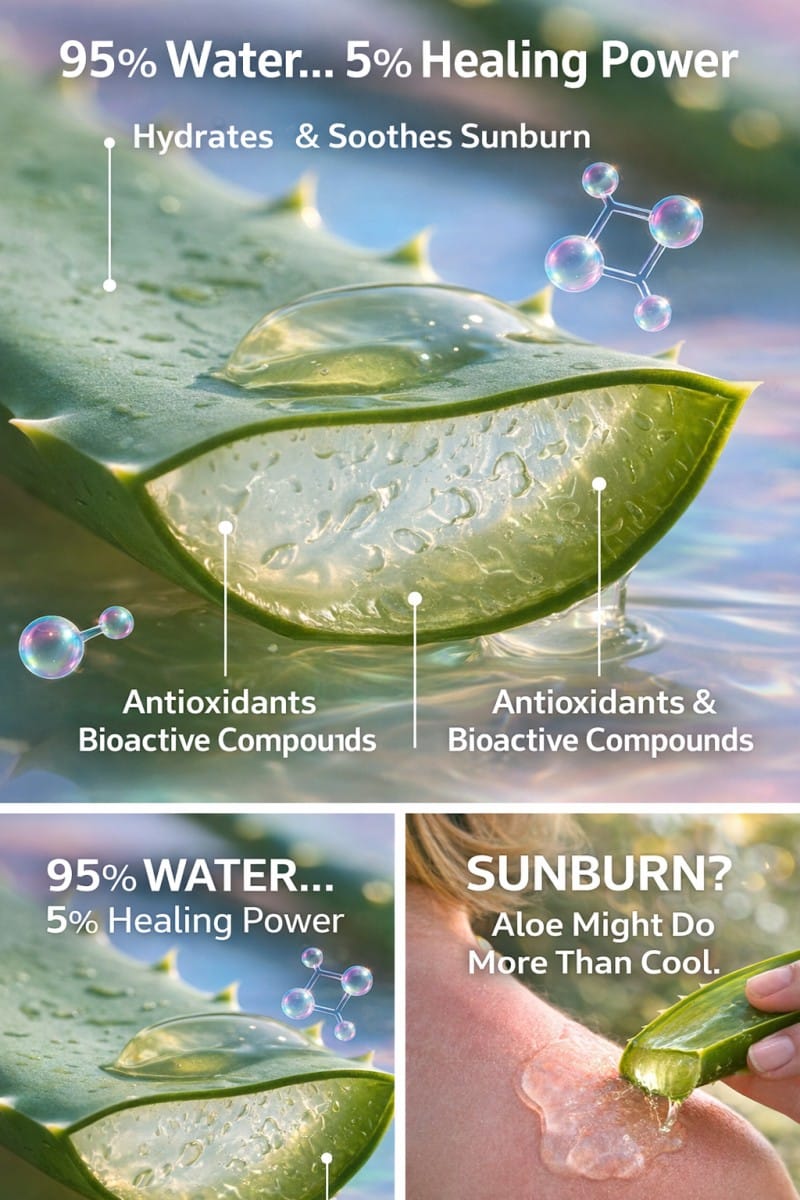
Aloe vera gel is about 95% water.
The remaining 5% is where the magic lives.
That 5% contains:
- Polysaccharides (like acemannan)
- Vitamins (A, C, E, B12)
- Minerals (zinc, magnesium)
- Amino acids
- Enzymes
- Anthraquinones (including aloin)
That small fraction is biologically active and highly therapeutic.
So no, it’s not “just water.”
It’s structured hydration + bioactive repair molecules.
2. Cooling & Soothing: Why Aloe Feels Instantly Calming
When applied to skin:
- High water content hydrates instantly
- Evaporation creates a natural cooling sensation
- Polysaccharides form a light film over skin
This does three things:
- Reduces inflammation
- Calms nerve endings (reduces burning sensation)
- Prevents further moisture loss
That’s why it’s a first aid hero for:
- Sunburn
- Mild skin burns
- Razor burns
- Post-wax irritation
It doesn’t just “cool.” It actively modulates inflammation.
3. Why Aloe Vera Works for Sunburn & Skin Burns
Sunburn is essentially UV-induced inflammation + cellular damage.
Aloe helps by:
- Reducing redness (anti-inflammatory effect)
- Hydrating damaged cells
- Increasing fibroblast activity (cells responsible for collagen production)
- Speeding epithelial repair (new skin formation)
Other Natural Options for Sunburn
If aloe isn’t available:
- Cold milk compress (lactic acid + proteins soothe)
- Cucumber pulp (high water + antioxidants)
- Honey (natural antimicrobial + healing)
- Oatmeal paste (anti-inflammatory)
But aloe remains one of the most studied natural burn remedies.
4. What Is Aloin? Is It Good or Bad?
Aloin is a yellow compound found in the latex layer just beneath the aloe leaf skin.
It belongs to a group called anthraquinones.
What does Aloin do?
- Strong laxative (when ingested)
- Mild antimicrobial
- Anti-inflammatory in controlled amounts
However:
- In skincare, excessive aloin can irritate sensitive skin.
- High-quality aloe gel products remove most aloin (decolorized aloe).
Is aloin found elsewhere?
Yes. Some anthraquinones are found in plants like senna and rhubarb roots, but aloe’s aloin is unique in structure and concentration.
So pure inner gel = safe and soothing.
Whole leaf latex extract = potentially irritating.
Big difference.
5. Antioxidants & “Anti-Damage” Protection
Aloe contains:
- Vitamin C
- Vitamin E
- Beta carotene
- Polyphenols
These neutralize free radicals caused by:
- UV exposure
- Pollution
- Oxidative stress
Free radicals damage collagen and accelerate aging.
Aloe doesn’t just hydrate.
It protects the skin from long-term structural breakdown.
6. How Aloe Boosts Collagen Production
This is where things get interesting.
Aloe stimulates fibroblasts.
Fibroblasts produce:
- Collagen
- Elastin
Acemannan (a key polysaccharide in aloe) has been shown to:
- Increase collagen synthesis
- Improve cross-linking of collagen fibers
- Speed wound contraction
Result?
- Faster healing
- Improved skin elasticity
- Reduced scar formation
That’s why aloe is used in minor wound care gels.
7. Protective Layer Against Infection
When applied to skin, aloe forms a thin protective film.
This layer:
- Locks in moisture
- Shields against environmental microbes
- Contains mild antimicrobial compounds
It’s not a replacement for medical antiseptic.
But for minor cuts, cracks, and irritation, it provides a protective micro-environment that supports healing.
8. Boosting Skin Repair & Barrier Function
Healthy skin barrier = less inflammation, fewer breakouts, less dryness.
Aloe helps by:
- Improving hydration
- Supporting lipid repair
- Reducing inflammatory cytokines
- Accelerating cell turnover in damaged areas
It works especially well for:
- Sensitive skin
- Acne-prone skin
- Post-procedure calming
- Winter dryness
9. Aloe Vera vs Other Traditional Remedies
What makes aloe different?
| Feature | Aloe Vera | Rose Water | Honey |
|---|---|---|---|
| Cooling | High | Moderate | Low |
| Collagen Boost | Yes | Minimal | Mild |
| Antimicrobial | Mild | Mild | Strong |
| Wound Healing | Strong | Low | Strong |
| Protective Film | Yes | No | Yes |
Aloe sits at the intersection of hydration + repair + protection.
It’s not just soothing. It’s regenerative.
10. Who Should Be Careful?
- Very sensitive skin (patch test first)
- Allergy to Liliaceae family plants
- Using whole leaf extracts with aloin
Always use pure inner leaf gel or certified formulations.
Final Take: Is Aloe Vera Overrated?
No.
It’s over-simplified.
People talk about it like it’s a kitchen hack.
In reality, it’s a biologically active skin repair system packed inside a plant.
95% water.
5% cellular intelligence.
That 5% is doing the heavy lifting.
Aloe Vera Myths vs Science
Myth 1: Aloe is just water.
Truth: The remaining 5% contains biologically active compounds that stimulate collagen and reduce inflammation.
Myth 2: Aloe cures everything.
Truth: It supports healing for minor burns and irritation but is not a replacement for medical treatment.
Myth 3: All aloe gels are the same.
Truth: Whole leaf extracts contain aloin, which may irritate skin. High-quality inner leaf gel is safer.
Myth 4: Aloe is only for sunburn.
Truth: It improves barrier repair, supports wound healing, and provides antioxidant protection.
⚠️ Medical Disclaimer
The information provided in this article is for educational and informational purposes only. It is not intended as medical advice, diagnosis, or treatment. Aloe vera may not be suitable for everyone, especially individuals with sensitive skin, allergies, or underlying medical conditions. Always perform a patch test before topical application and consult a qualified healthcare professional or dermatologist for persistent skin issues, severe burns, or medical concerns.
This content does not replace professional medical consultation.
References
- Surjushe A, Vasani R, Saple DG — Aloe vera: A Short Review
Indian Journal of Dermatology, 2008 — full text & open access available on PubMed Central. - Chithra P, Sajithlal G, Chandrakasan G — Influence of Aloe vera on collagen characteristics in healing dermal wounds
Molecular and Cellular Biochemistry 1998 — PubMed listing. - Aloe vera and collagen, fibroblast effects (supporting collagen synthesis)
Aloe Vera for Tissue Engineering Applications (MDPI) — discusses fibroblast stimulation and increased collagen content. - Systematic review of Aloe vera biological effects
Evaluation of biological properties and clinical effectiveness of Aloe vera: A systematic review — broader overview of wound healing and collagen roles.
Frequently Asked Questions (FAQ)
Q: 1. Is aloe vera really good for skin?
A: Yes. Aloe vera contains polysaccharides, antioxidants, and vitamins that hydrate skin, reduce inflammation, and support collagen production.
Q: 2. Does aloe vera increase collagen production?
A: Aloe vera stimulates fibroblast activity, which increases collagen synthesis and improves wound healing and skin elasticity.
Q: 3. Can aloe vera heal sunburn?
A: Yes. Aloe vera reduces inflammation, hydrates damaged skin cells, and accelerates epithelial repair, making it effective for mild sunburn.
Q: 4. What is aloin in aloe vera?
A: Aloin is a yellow compound found in the latex layer of aloe leaves. It has laxative and antimicrobial properties but may irritate skin if not removed in cosmetic products.
Q: 5. Is aloin harmful for skin?
A: In high concentrations, aloin can irritate sensitive skin. Most skincare-grade aloe products remove excess aloin for safety.
Q: 6. Does aloe vera protect against infection?
A: Aloe contains mild antimicrobial compounds and forms a protective film over skin, helping reduce risk of minor infections.
Q: 7. Can aloe vera help acne-prone skin?
A: Yes. Its anti-inflammatory and hydrating properties help calm redness, reduce irritation, and support barrier repair without clogging pores.
Q: 8. How often can aloe vera be applied to the face?
A: Pure aloe gel can be applied 1–2 times daily. Always perform a patch test before regular use.